

I have recently stumbled across one of the most impressive, hardcore retro computing efforts I’ve ever encountered. A reader, Pascal (a.k.a. Kroah), broke into chat with me the other day, indicating that he had been searching for months and months for the manual to the game Time Bandit. He saw a photo I had linked on the Usenet several years ago, in which the manual was pictured in the background. It was chance that he found me here at Byte Cellar, but now that he had, could I provide it? I could.
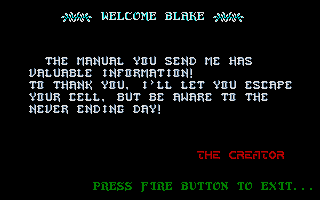
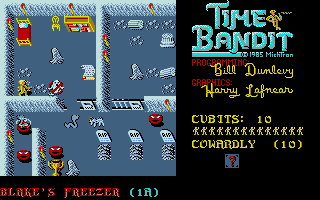
Why did he want the Time Bandit manual? He is building a sequel. How, you ask? With the Time Bandit Utility of his creation. You see, Kroah’s passion is “decompilation”. That is, breaking a game down to its basics, and then building a easy-to-use tool–GUI and everything, that allows editing of level maps, graphics, game scripts, etc. Coded in in C# under .NET, his Time Bandit Utility allows you to modify the core game, or go far beyond and create more or less a whole new game based on the original engine. The images above are just a quick demonstration of what can be done with the tool. Good stuff, eh? Well – it gets better. It’s not just the Atari ST classic Time Bandit he has decompiled; a host of classic games have gone under the knife, as can be seen at his page: Captain Blood, Archon, Seven Cities of Gold, M.U.L.E., Gateway to Apshai and more–classics, all.
Kroah tells me that he follows a certain drill in decompilation:
- Decompile and decrypt the game with an
- Understood the whole data and code
- Make a tool to read/write the data (and updating some game code)
- Doing new levels before releasing the custom tool. I wasn’t able to go
further this step until now because I wanted to use the same background
story. But without the manual, how did I know it? Even if the manual didn’t
say anything, I wanted to be sure to not go across something interesting. - Now I’m going to read it, and beginning working on a cool story (at last,
I’ll try!). - Building the levels (this take time…)
- Release the new levels and wait the community feedbacks.
- Release the tool.
Very impressive work and it’s amazing to have these insights into some of the games of olde we loved the best.
Now that you mention it, I could use some help with the 1993 release of Seven Cities of Gold…
Specificaly getting it to read the VALUES.CFG file…
I know this prolly isn’t the place to ask for this help, but I’ve not yet come accross ANYTHING relating to this issue…
Thanks,
~Cadi
I would also like to know how to edit the file for Seven Cities of Gold
Pingback: A Glimpse of the Elusive ‘Time Bandit’ for the Sanyo MBC 550 | Byte Cellar