

I was recently flipping through the pages of the January 1986 issue of inCider magazine when I ran across a brief write-up (edited by Paul Statt) of a seemingly magical Apple II peripheral: the Abaton Transform board.
As inCider describes it:
Abaton Transform automatically regenerates Apple II applications for instant use on the Macintosh. Abaton translates II programs, including screen graphics, at the object-code level for the Macintosh, regardless of the original program’s source language. The process often takes less than 15 minutes, and even the most sophisticated programs are translated in no more than six hours. Copy protected programs cannot be translated; Abaton is intended for developers’ use. Abaton Transform comes with an add-on card for the Apple II, and 5.25 and 3.5-inch disks. Your Macintosh needs at least 512K. The price is a mere $1995, from Abaton Technology, 1526 Cloverfield Boulevard, Santa Monica, CA 90404, (818) 905-9399.
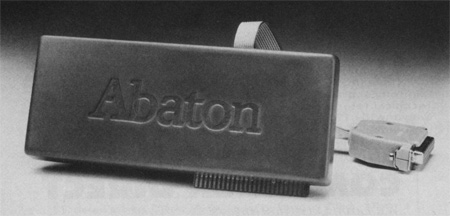
Did this product ever make it to market? It seems amazing that I’ve never heard of it before. How did the Abaton Transform work its magic? Quite an interesting device.
UPDATE: Reader Carlos Bragatto, in a comment on this post, informed me that the Abaton Transform was designed by Byron Wagner, no stranger to transforming computer object code between dissimilar CPUs. (Thanks Carlos!) I shot Byron an email and he responded with more info about the Transform board.
Byron points out that the Transform was more software than hardware…
The two second explanation is that the epoxied card was literally a red herring. It only served as a serial port into the Apple II so we could access the funky floppy drive. All the real work in the cross compiling was done on the 68000, but we hadn’t received the patents yet, so didn’t want anyone to easily figure it out…
He informed me that the translated apps ran full-screen, which was a challenge since the originals Mac’s 512×342 screen resolution was slightly lower than twice that of the Apple II’s 280×192 hi-res graphics screen. When asked about the speed of the resultant Macintosh executables–if games play at full speed, for instance, Byron indicated that slowness was not a problem.
Way faster. So much faster (6x, if I remember correctly) we typically had to pad the UI to run properly! Consider 68000 vs. 6502 horsepower and clock rates, and that we were transmapping opcodes.
Games were our benchmark. We did graphics, sound, input, and everything else (except color, of course, which became grayscale/halftones). We usually demo’d by converting Millipede, and other games we’d hacked copy protection on, and whose source code we’d never seen, in realtime. Any feature (logical branch) of the original code that was exercised during the conversion demo was supported in the target version it created on the spot.
Thanks for the additional info, Byron. The Abaton Transform sounds like a most interesting technology, indeed.
You can ask the guy who did the thing:
http://web.mac.com/bdw/Claker.com/Bio.html
Carlos
What an interesting idea. I wonder if any developers used the Abaton Transform to create Macintosh versions of their software. I also wonder how it handled self-modifying 6502 code.
What a neato device !
A hardware version of “][-In-A-Mac” !
8^ ]
Re: A hardware version of “][-In-A-Mac”
See here:
http://en.wikipedia.org/wiki/Apple_IIe_Card